One Man’s Tournament, A King’s Domain
1986 World Cup Review
In the summer of 1986, football gathered in Mexico. Twenty-four teams arrived with plans, systems, and expectations.
What followed was not simply a tournament. It was a sequence of matches where structure bent to individual influence, and collective effort revolved around a single focal point.

This was a World Cup shaped by context—economic crisis, national recovery, tactical evolution—and defined by moments that refused to fade. A competition remembered not only for its results, but for how the game itself was interpreted on the field.
Tournament Overview
The summer of 1986.Twenty-four teams on stage. The world’s attention focused on one place. The dominance of one man. The birth of a football king. Yet the story was never that simple.
From May 31 to June 29, 1986, the 13th FIFA World Cup was held in Mexico. The tournament left behind countless moments that would later become part of football history. Originally, the hosting rights belonged to Colombia, but a severe economic crisis forced the country to withdraw.
Mexico stepped in and became the first nation to host the World Cup twice, having previously done so in 1970.
Eight months before the tournament, Mexico suffered a devastating earthquake that claimed nearly 25,000 lives. Despite this tragedy, the country fulfilled its commitment and successfully staged the World Cup as scheduled.
Tournament Format
Following the expansion introduced in 1982, the 1986 World Cup again featured 24 teams, though the competition format was slightly adjusted. The teams were divided into six groups. The top two teams from each group, along with the four best third-placed teams, advanced to the round of 16. From that point onward, all matches were decided by single-elimination.

Matches were played across twelve stadiums. The Estadio Azteca hosted nine games, including the final, making it the venue with the most matches during the tournament.
Group Stage
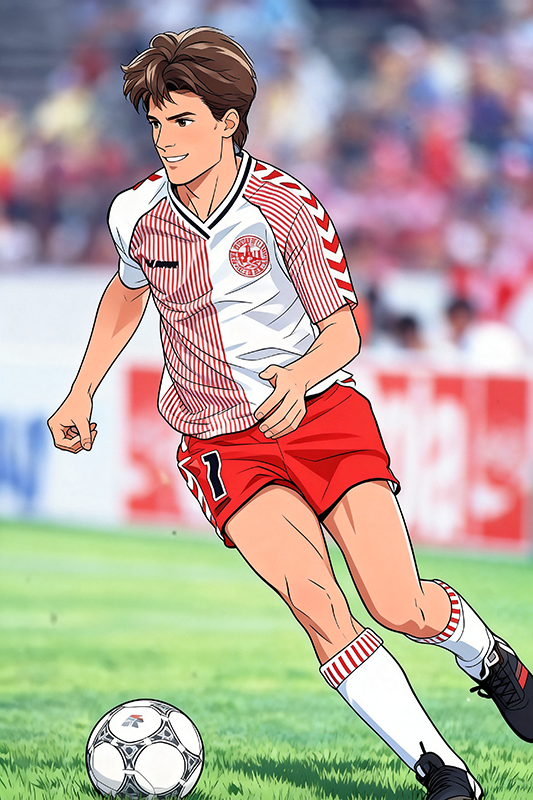
During the group stage, every team pushed hard in pursuit of qualification. Denmark emerged as the biggest surprise. Led by their star player Michael Laudrup, Denmark opened with a 1–0 victory over Scotland, followed by a stunning 6–1 demolition of Uruguay. In their final group match, they defeated defending runners-up West Germany 2–0, finishing with three wins and a goal difference of +8 to top the group.
Morocco also made history. Drawn into a group with England, Poland, and Portugal, they were widely expected to be eliminated early. Instead, Morocco topped the group, becoming the first
African team to advance to the knockout stage of a World Cup.
The remaining group winners were Argentina, Mexico, the Soviet Union, and Brazil.
Round of 16
With single-match elimination, no team could afford mistakes. Denmark’s miracle run came to an end in a 1–5 defeat against Spain. Morocco pushed West Germany deep into the match, but a late free kick from Lothar Matthäus sealed their exit. Defending champions Italy were eliminated by France, while Brazil, Argentina, and England advanced.

Quarter-Finals
The quarter-finals delivered true heavyweight clashes. Brazil versus France became one of the tournament’s most memorable matches. Zico missed a decisive penalty in regulation time, and France ultimately prevailed in the penalty shootout.

Hosts Mexico were eliminated by West Germany, also on penalties. Argentina faced England in a match filled with drama. Diego Maradona scored the controversial “Hand of God” goal and later produced a historic solo run, dribbling past six defenders. Argentina won 2–1 and eliminated England.
Semi-Finals
Four years after their previous meeting, France and West Germany met again. In a duel between Matthäus and Platini, West Germany’s resilience prevailed in a 2–0 victory.

In the other semi-final, Maradona scored twice for the second consecutive match. Belgium could not stop him, and Argentina secured a 2–0 win to reach the final.
The Final
On June 29, 1986, the Estadio Azteca was filled to capacity. Argentina faced West Germany, with the World Cup trophy at stake. Argentina led 2–0 through goals in the 23rd and 55th minutes.
West Germany responded with two goals of their own. In the 83rd minute, Maradona delivered a decisive assist to Jorge Burruchaga, who scored the winning goal. Argentina claimed a 3–2 victory and lifted the trophy.

After the match, scenes of Maradona singing with his teammates in the dressing room became one of the enduring images of World Cup history.
Awards
Best Player: Diego Maradona (Argentina)
Silver Ball: Harald Schumacher (West Germany)
Bronze Ball: Preben Elkjær (Denmark)

Top Scorer: Gary Lineker (England) – 6 goals
Best XI (4–3–3)
Goalkeeper: Schumacher (West Germany)
Defenders: Josimar (Brazil), Bossis (France), Briegel (West Germany), Larsen (Denmark)
Midfielders: Platini (France), Maradona (Argentina), Burruchaga (Argentina)
Forwards: Elkjær (Denmark), Lineker (England), Careca (Brazil)
Classic Encounters
Brazil vs France
Two title contenders met head-on. Brazil entered unbeaten with nine goals scored and none conceded. Careca opened the scoring, but Platini equalized before halftime. Zico missed a late penalty, and France advanced after a shootout, with goalkeeper Joël Bats playing a decisive role. After the match, Platini consoled Zico, a moment of mutual respect between two legendary number tens.
Argentina vs England
Political tensions heightened the rivalry. On the pitch, Argentina prevailed. Maradona scored first with his hand, unnoticed by the referee. Minutes later, he completed one of the greatest goals in football history, dribbling past six English players. England pulled one goal back through Lineker, but Argentina won 2–1.
Argentina vs West Germany
The final proved unforgettable. Argentina controlled the first half and led 2–0. West Germany fought back to equalize. Four minutes later, Maradona delivered a perfectly weighted through ball to Burruchaga, sealing Argentina’s victory.
The King’s Star
The 1986 World Cup belonged to Diego Maradona. No other tournament has carried such a clear individual imprint. Argentina scored 14 goals; Maradona contributed directly to 10, with five goals and five assists.

His performances sparked a tactical shift. Argentina’s coach Carlos Bilardo designed a system centered entirely around him. Eight years later, when Maradona retired, this “star-centered” approach faded, and collective football regained dominance.
Eternal Moments
The Hand of God
A miscontrolled clearance led to a high ball into the box. Maradona leapt and used his hand to score. The referee allowed the goal to stand despite protests. Maradona later described it as a moment shaped by political tension and personal instinct.

The Goal of the Century
From near the halfway line, Maradona turned, accelerated, and dribbled past six English players before scoring. The goal remains one of the most celebrated in World Cup history. Today, a statue outside the Estadio Azteca commemorates the moment.
Final Notes
The official mascot was “Pique,” a chili pepper wearing a sombrero.
The official match ball, “Azteca,” was the first synthetic World Cup ball.
Mexico’s coach Bora Milutinović began a record run of World Cup appearances.
Uruguay recorded the fastest red card in World Cup history.
China’s failed qualification became known as the “5–19 Incident.”

When the final whistle sounded at the Estadio Azteca, the tournament had already left its imprint.
Goals were counted.Trophies were awarded.But the defining legacy lay elsewhere—in decisions made in motion, in risks taken under pressure, and in a style of control rarely seen before or since.
Years later, the matches remain replayed, the moments revisited.Not because they belong to the past, but because they continue to explain how one tournament redefined what influence on the game could look like.


Comments